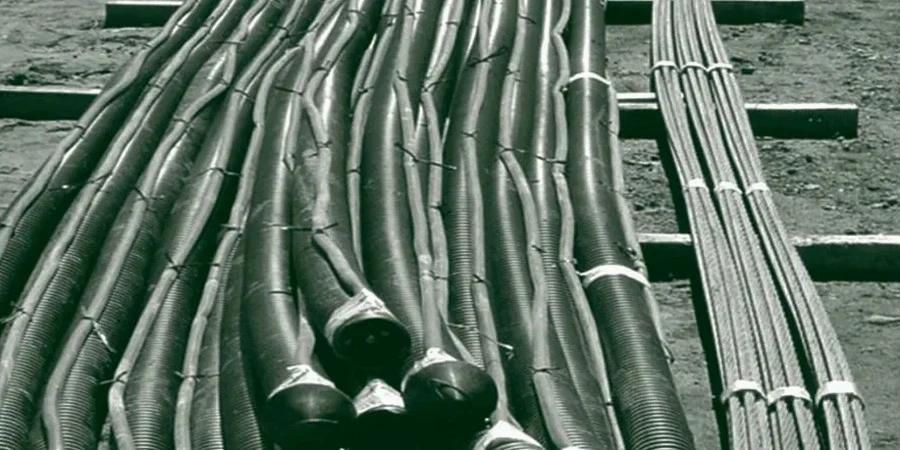
The hollow‑stem auger rig spins down through the silty sand, and the crew from the geotechnical lab watches the cuttings change color at about 18 feet — that’s the typical Pleistocene‑Holocene contact we see all across Norfolk. Once the borehole reaches design depth, a high‑strength Dywidag threadbar or strand tendon is lowered into the hole, and neat cement grout is tremied from the bottom up. Norfolk’s coastal plain is a sequence of loose sands, soft clays, and occasional shell hash, so the bond zone has to be placed with real precision: too shallow and you’re in fill, too deep and you risk punching into the Yorktown Formation before you’ve developed enough skin friction. The team runs a water‑pressure test before grouting, watching for loss zones that would bleed grout into the permeable sand lenses. Every anchor assembly is built with double‑corrosion protection — epoxy‑coated bar inside a corrugated HDPE sheath, centralizers every 10 feet — because the brackish groundwater here, fed by the Elizabeth River and the Chesapeake Bay, is aggressive to steel. For projects near the waterfront, where tidal fluctuation creates a cyclic wet‑dry zone in the upper ten feet, we pair the anchor design with a deep excavation monitoring program that tracks load cells and inclinometers in real time, ensuring the tieback wall performs as modeled during the spring tide cycles.
In Norfolk's groundwater, corrosion protection is not optional — a double‑encapsulated tendon with epoxy‑coated bar is the minimum standard we specify for any permanent anchor within the tidal influence zone.
How we work
Local ground factors
Norfolk’s development history has left a hidden risk in the soil column: the city sits on a filled marshland that was gradually raised during the late 1800s and early 1900s. Much of the downtown core, from the NEON District to the waterfront, is underlain by uncontrolled fill that can contain anything from dredged river silt to demolition debris. When an excavation for a tied‑back wall cuts into that fill, the passive resistance in front of the wall can be far lower than the geotechnical report assumes if the borings missed a pocket of loose, saturated sand. The team has seen this happen on a project near the Hague basin, where a passive anchor zone had to be deepened on the fly after the excavation revealed a lens of fluidized silt that had no measurable undrained shear strength. The lab’s protocol now includes a mandatory pre‑construction test pit in the passive zone for any project within 500 feet of the Elizabeth River shoreline, verifying the stratigraphy against the original boring logs before the shoring contractor mobilizes. The other local risk is long‑term creep in the soft organic clays that underlie much of the southern part of the city — anchor lock‑off loads can relax by 12 to 15% over the first six months, so the design includes an over‑lock provision that the field crew adjusts during the first re‑stressing visit.
Regulatory framework
IBC 2021 (International Building Code), ASCE 7‑22 Minimum Design Loads for Buildings, PTI DC‑35.1 Recommendations for Prestressed Rock and Soil Anchors, ASTM A722 Standard Specification for High‑Strength Steel Bars for Prestressed Concrete
Related services
Active anchor design and testing
Full design of prestressed tieback anchors for deep excavations and retaining walls, including bond length calculations in Norfolk's stratified sands, cyclic proof testing to 133% of design load, and long‑term monitoring plans with scheduled re‑stressing intervals.
Passive anchor and soil nail systems
Design of passive bar anchors and grouted soil nails for slope stabilization and wall support in Norfolk's fill and residual soils, with pullout resistance verification through on‑site testing and grout take measurements that account for the variable subsurface conditions.
Typical parameters
Quick answers
What does an active and passive anchor design cost for a project in Norfolk?
The fee for a complete anchor design package, including the geotechnical calculations, construction drawings, and the on‑site proof testing supervision, runs between US$890 and US$3,370 depending on the number of anchors, the complexity of the stratigraphy, and whether the project requires a corrosion risk assessment specific to Norfolk's brackish groundwater. Larger shoring projects with multiple anchor rows and long‑term monitoring specifications will be at the upper end of that range.
How does the lab determine the bond length for an anchor in Norfolk's soil?
The bond length is calculated from the soil‑to‑grout interface shear strength, which is derived from in‑situ testing — typically a CPT sounding that provides continuous sleeve friction data through the sand and clay layers. The team applies a factor of safety of 2.0 for permanent anchors and 1.5 for temporary construction anchors, then verifies the assumed strength through on‑site pullout testing on sacrificial anchors before the production anchors are installed. Norfolk's Yorktown Formation sands typically allow bond stresses in the range of 15 to 30 psi for pressure‑grouted anchors.
Which corrosion protection system is required for permanent tieback anchors in Norfolk?
Because Norfolk's groundwater is brackish and often has a pH between 5.5 and 7.0, the lab specifies a double‑encapsulation system as the minimum for all permanent anchors. This includes an epoxy‑coated high‑strength bar or strand, a corrugated plastic sheath over the entire unbonded length, and a second sheath over the bond zone with the annular space filled with cement grout. The anchor head is sealed with a grease‑filled protective cap and a neoprene gasket to prevent oxygen ingress. This system meets the PTI Class II protection requirements and is designed for a 75‑year service life even under the cyclic wet‑dry conditions common near the Elizabeth River.