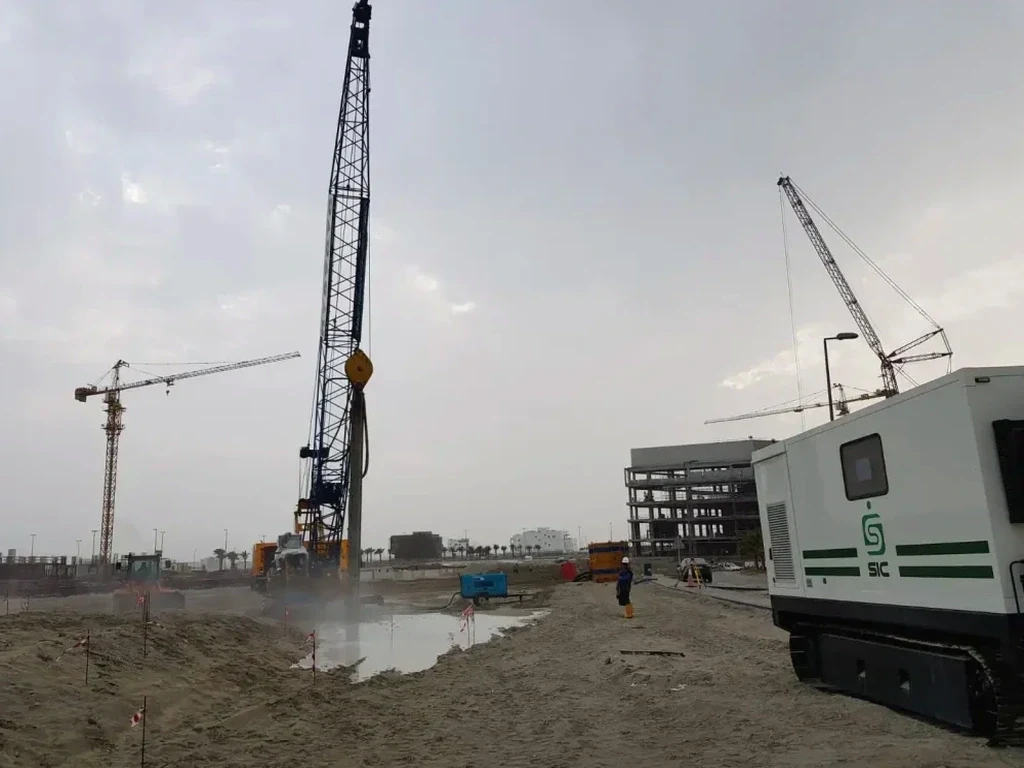
The coastal plain around Norfolk doesn't forgive poor ground preparation. With the water table sitting barely four feet below grade across much of the city and layers of loose Holocene sand deposited by the Chesapeake Bay system, anyone breaking ground here deals with soils that compact poorly under static load. Vibrocompaction design becomes the rational path when standard fill-and-roll methods won't achieve the required relative density. We've seen too many sites in the Ghent and Ocean View neighborhoods where differential settlement showed up within two years of construction — always traceable back to untreated loose sand lenses. A proper design sequence uses in-situ testing to map those lenses, defines target density based on the structural load and seismic demand, and specifies probe spacing, vibration duration, and water or air flush parameters that actually match Norfolk's subsurface profile. Done right, the ground stops being a liability and becomes a predictable bearing stratum.
Vibrocompaction isn't guesswork — it's a density specification written around Norfolk's poorly graded sands and high groundwater.
How we work
Local ground factors
One thing we notice repeatedly on Norfolk projects: owners assume that because the site looks flat and sandy, compaction is a non-issue. That assumption backfires when the contractor runs a few passes with a smooth-drum roller, gets a passing proof roll, and calls it good — while loose sand at eight to twenty feet goes completely untreated. Two years later, the slab shows settlement cracks and the stormwater pipes have separated at the joints. The real risk isn't the surface; it's the deep lens of underconsolidated sand that sat below the water table since the last glacial cycle and never felt a significant overburden. Vibrocompaction design catches that lens before the concrete goes in. It specifies depth, grid geometry, and energy input so the improvement reaches the full zone of influence. Skipping the design phase means the contractor is operating blind — and Norfolk's geology is too variable for that.
Explanatory video
Regulatory framework
IBC 2021 Section 1805 (Ground Improvement), ASCE 7-22 Chapter 20 (Site Classification Procedure), ASTM D2487 (Unified Soil Classification System), ASTM D1586 (Standard Penetration Test), FHWA NHI-16-072 Ground Improvement Manual
Related services
Pre-design subsurface characterization
CPT soundings and SPT borings to map loose sand lenses, establish pre-treatment relative density, and confirm fines content for vibratory suitability.
Vibrocompaction grid and depth design
Triangular or square grid layout with probe-by-probe depth targets, frequency-amplitude parameters, and compaction energy specification tied to IBC performance criteria.
Real-time QC during treatment
Monitoring of hydraulic pressure, ammeter draw, and penetration rate with daily logs — adjusting parameters when subsurface conditions deviate from the baseline model.
Post-treatment verification testing
CPT or SPT comparison before and after compaction, plus sand cone density tests at selected depths to confirm the design relative density has been achieved across the treatment zone.
Typical parameters
Quick answers
What does vibrocompaction design cost for a typical Norfolk residential lot?
For a standard single-family lot in Norfolk, vibrocompaction design including pre-treatment CPT soundings, the grid plan, QC protocol, and post-treatment verification typically runs between US$1,620 and US$4,740 depending on site access, treatment depth, and the number of probes required. Larger commercial parcels cost more because of the expanded testing grid.
How does Norfolk's high water table affect vibrocompaction?
The shallow groundwater — often just four feet below the surface in Norfolk — actually helps the process. Saturated clean sand transmits vibratory energy more efficiently than dry sand, so we typically use a wet method with water flush. The design accounts for backpressure and specifies probe withdrawal rates that prevent suction and keep the borehole open during treatment.
What soil types in Norfolk respond best to vibrocompaction?
Clean sands and sands with less than 12 percent fines are ideal. The Norfolk Formation's poorly graded sands fit this profile well. Silty sands can still be treated but require closer probe spacing. If the fines content exceeds 20 percent, we usually recommend switching to stone columns or another deep mixing approach — vibrocompaction loses effectiveness when the soil can't drain the excess pore pressure generated during vibration.
How long does the design and treatment process take?
The design phase, with field investigation and engineering analysis, takes one to two weeks. On-site treatment for a typical Norfolk residential or light commercial lot runs one to three days. Post-treatment verification adds another day. So from mobilization to final report, plan on two to three weeks total, weather permitting.
Is vibrocompaction enough for Norfolk's seismic requirements?
Norfolk sits in a moderate seismic hazard zone, and the IBC references ASCE 7 site classification. Vibrocompaction designed to achieve 70 to 85 percent relative density typically moves a Site Class D or E profile into Site Class C, which reduces the seismic design forces on the structure. We verify the improvement with post-treatment shear wave velocity measurements when the project requires it. More info.