The soil profile beneath Norfolk tells two very different stories depending on where you stand. Over in Ghent, century-old brick buildings rest on relatively competent Pleistocene deposits, while just a few miles south near the Elizabeth River terminals, borings routinely encounter 30 to 40 feet of soft, highly compressible organic silts and loose hydraulic fill that would swallow a conventional footing before the first floor joist is installed. That contrast is exactly why stone column design in this city cannot rely on textbook assumptions: every site demands a forensic reading of the subsurface investigation, cross-referenced with tidal influence and the rapid urban densification that defines Hampton Roads today. When we approach a site near the Lafayette River or along the Broad Creek tributary, we integrate CPT test data to map the undrained shear strength profile continuously, which allows the column grid to be tuned to the actual thickness of the compressible layer rather than a conservative blanket assumption. For projects where settlement tolerance is exceptionally tight—think medical facilities near Sentara Norfolk General or data infrastructure along Military Highway—we also draw on liquefaction assessment protocols from ASCE 7-22 to confirm that the stone column array performs under both static and seismic demand, given Norfolk's location in a moderate seismic hazard zone with Site Class E or F soils predominating along the waterfront.
In Norfolk's tidal-influenced soils, a properly designed stone column grid transforms a Site Class F profile into a buildable platform that meets the 1-inch total settlement criterion without over-excavation.
How we work
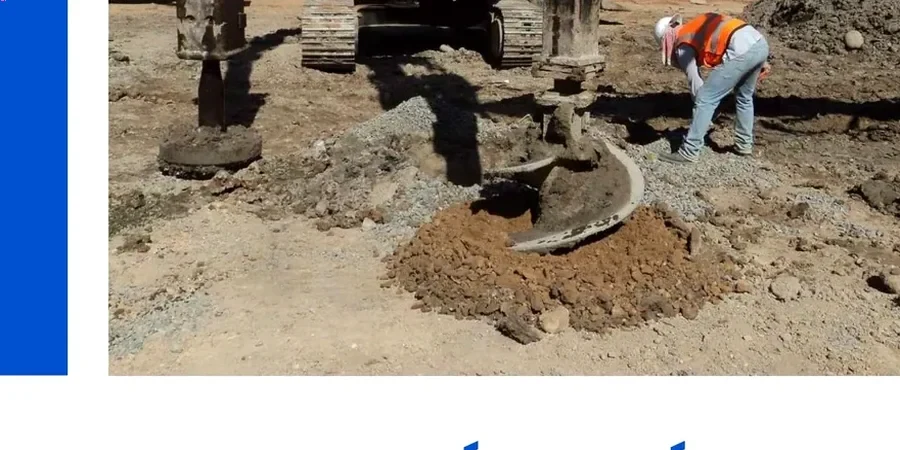
Local ground factors
The coastal humidity and shallow groundwater that define Norfolk's climate introduce a risk that rarely appears in drier inland markets: pore pressure buildup during vibroflotation can temporarily liquefy the surrounding fine sand lenses, causing a momentary loss of lateral confinement before the stone column fully forms. This phenomenon is particularly pronounced in the silty tidal marsh deposits that fringe the Lafayette and Elizabeth River shorelines, where the stratigraphy alternates between loose sand and organic clay every few feet. If the installation sequence and probe withdrawal rate are not calibrated to the real-time pore pressure response, the column can neck or lose continuity, leaving a weak segment that compromises load transfer from the footing or mat above. Our design protocol includes a pre-production test section with piezometer monitoring at three depths, which allows the field parameters to be locked in before the production grid begins. In the event that pore pressure dissipation is slower than anticipated—common in the fat clays of the lower Yorktown Formation—we adjust the sequencing to a staggered pattern with longer set times between adjacent columns, ensuring the ground improvement performs uniformly across the entire building footprint.
Regulatory framework
ASCE 7-22 (Minimum Design Loads and Associated Criteria for Buildings and Other Structures), IBC 2021 (International Building Code, Chapter 18: Soils and Foundations), ASTM D1586 (Standard Test Method for Standard Penetration Test and Split-Barrel Sampling of Soils), ASTM D2487 (Standard Practice for Classification of Soils for Engineering Purposes), FHWA-NHI-16-072 (Ground Improvement Methods, Volumes I and II)
Related services
Feasibility & Pre-Design Analysis
We review existing SPT borings and CPT soundings from your Norfolk site to determine whether stone columns are geotechnically suitable, estimating the replacement ratio and column depth needed to achieve your settlement and bearing capacity targets under ASCE 7 load combinations.
Production-Ready Stone Column Design
A sealed design package that includes column layout, grid spacing, stone gradation specification per ASTM D448, installation sequence, and predicted settlement curves. The design accounts for Norfolk's high groundwater and variable Yorktown Formation stratigraphy.
QA/QC & Post-Treatment Verification
We specify and interpret plate load tests and modulus verification using full-scale zone testing, confirming that the installed stone column array meets the 1-inch settlement criterion before structural work begins.
Typical parameters
Quick answers
What does stone column design cost for a typical Norfolk commercial site?
For a commercial building footprint between 5,000 and 15,000 square feet in Norfolk, the combined design engineering and full-scale load test verification typically ranges from US$1,690 to US$5,030. The exact figure depends on the number of borings already available, the required column depth—which in Norfolk often runs 25 to 35 feet to reach competent bearing—and whether a pre-production test section is mandated by the geotechnical engineer of record.
How do stone columns perform in Norfolk's high-water-table conditions?
Stone columns actually perform well in saturated soils because the vibroflotation process displaces water laterally while compacting the aggregate, and the finished column acts as a vertical drain that accelerates consolidation of the surrounding clay. In Norfolk, where the groundwater table is routinely within two feet of grade, we use the wet top-feed method and monitor pore pressure during installation to prevent necking in the upper portion of the column.
What is the minimum soil strength needed for stone columns to work?
Stone columns require a minimum undrained shear strength of approximately 15 to 20 kPa (300 to 400 psf) in the surrounding soil to provide adequate lateral confinement. In Norfolk's softer estuarine deposits, we verify this threshold using CPT tip resistance and field vane shear data before committing to the technique. If strengths fall below that range, we evaluate complementary methods such as deep soil mixing or rigid inclusions.