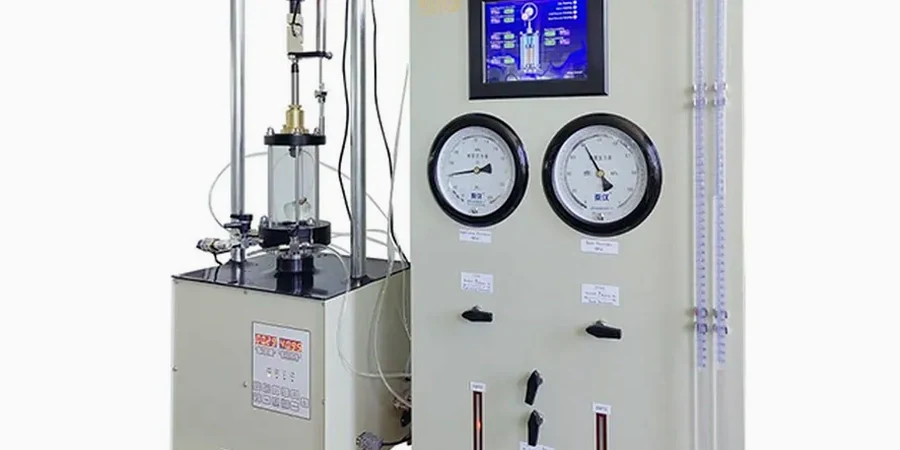
Most contractors here learn the hard way that Norfolk's soil doesn't forgive assumptions. The coastal plain sediments—layers of marine clay, silt, and loose sand—shift behavior dramatically when saturated. We see it every season: a foundation designed on textbook values fails because no one ran a proper triaxial test. The triaxial test gives us drained and undrained shear strength under controlled confinement. That data directly feeds bearing capacity calculations and slope stability models. Without it, you're guessing how the soil handles the water table sitting at three feet. We run these tests daily in our lab, applying cell pressures that replicate actual overburden stress at depth. Pairing this with an in-situ permeability test often reveals just how fast the groundwater moves through the Norfolk Formation.
Effective stress parameters from a CU triaxial test beat any empirical correlation when the water table is less than five feet below grade.
How we work
Local ground factors
IBC Chapter 18 and ASCE 7-22 require site-specific shear strength for any structure in Seismic Design Category C or higher. Norfolk sits on Site Class E and F soils across much of the city, where soft clay profiles amplify ground motion. Using default presumptive bearing values from the code table is not permitted for these conditions. The risk is bearing capacity failure or excessive differential settlement under seismic loading. We've seen it in the Ghent and Ocean View neighborhoods where old fill over marsh deposits creates a classic weak-layer scenario. A CU triaxial test with pore pressure measurement gives the design team the undrained shear strength ratio needed for a cyclic loading analysis. Ignoring this step leaves the structural engineer blind to how the foundation soil will actually perform during a hurricane or the next magnitude 5.8 event along the Central Virginia Seismic Zone.
Regulatory framework
ASTM D4767-11: Standard Test Method for Consolidated Undrained Triaxial Compression Test for Cohesive Soils, ASTM D2850-15: Standard Test Method for Unconsolidated-Undrained Triaxial Compression Test on Cohesive Soils, ASTM D7181-20: Method for Consolidated Drained Triaxial Compression Test for Soils, IBC 2021 Section 1803: Geotechnical Investigations, ASCE 7-22 Chapter 20: Site Classification Procedure
Related services
CU Triaxial with Pore Pressure
The standard for effective stress analysis. We saturate the specimen under back pressure, consolidate to in-situ stress, then shear at a slow rate while measuring excess pore pressure. Outputs c' and φ' for long-term slope stability and foundation design.
UU Triaxial (Quick Undrained)
Fast turnaround for short-term bearing capacity. No drainage allowed during shear. We run three specimens at different confining pressures. Ideal for checking temporary excavation stability in saturated Norfolk clay.
CD Triaxial (Drained)
For free-draining sands and gravels where pore pressure dissipates quickly. We shear slowly enough to keep excess pore pressure near zero. Used for long-term settlement analysis of shallow footings on sandy strata.
Cyclic Triaxial for Seismic
Evaluates liquefaction potential and cyclic strength degradation. We apply sinusoidal axial loads to simulate earthquake shaking. Critical for sites mapped in the 100-year floodplain with loose sand layers.
Typical parameters
Quick answers
How much does a triaxial test program cost in Norfolk?
A standard set of three CU triaxial tests typically runs between US$1,980 and US$2,930 total, depending on sample condition and required confining stress levels. UU tests fall at the lower end. Cyclic triaxial programs cost more due to the extended test duration and specialized equipment. We always provide a fixed quote after reviewing the Shelby tube recovery and project specs.
What sample quality do you need for a valid triaxial test?
We need undisturbed Shelby tube samples with a recovery ratio above 80% and no visible cracks or gravel lenses. ASTM D4767 specifies a minimum diameter of 1.4 inches. Samples that have dried out or been heavily disturbed in transport won't yield reliable effective stress parameters. We inspect every tube before extrusion.
How long does it take to get triaxial test results?
A CU triaxial program on cohesive soil takes 5 to 7 business days from sample setup to final report. Saturation alone can take 48 hours for low-permeability clays. UU tests are faster—typically 2 to 3 days. We email preliminary c' and φ' values as soon as the shear stage finishes so you can keep the design moving.