Norfolk sits on the Atlantic Coastal Plain, where thick sequences of unconsolidated sediments overlie crystalline basement rock. The water table is often less than 6 feet below grade in the city’s low-lying areas. These conditions amplify seismic waves, making site-specific seismic microzonation essential even for moderate design earthquakes. A project on Granby Street encounters completely different ground response than one near the Lafayette River, yet generic code spectra ignore that variability. Our approach integrates deep shear-wave velocity profiling from MASW with site response analysis to map spectral acceleration at the surface. In areas where loose saturated sands are present, we overlay liquefaction potential indices derived from CPT testing, giving structural engineers a complete picture of geohazard exposure.
Coastal Plain sediments can amplify long-period energy by a factor of 3 or more relative to rock outcrop motion—ignoring site effects is a design error.
How we work
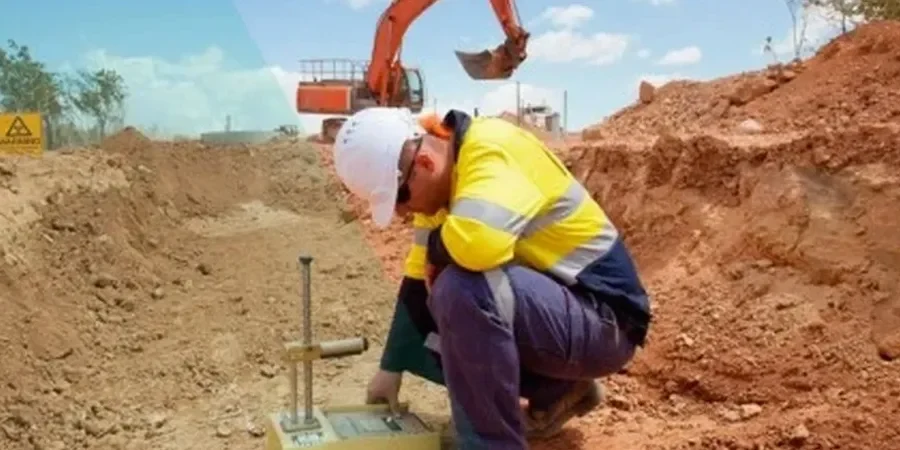
Local ground factors
A mid-rise residential project near the Elizabeth River waterfront required a seismic microzonation study after preliminary borings showed 15 meters of soft organic silt over dense sand. The structural engineer planned a mat foundation, but our site response analysis revealed a fundamental period of the soil column close to 1.0 second—nearly resonant with the 12-story structure. Without the microzonation, the design would have underestimated spectral demands by almost 40%. We adjusted the design spectrum upward and recommended ground improvement via vibrocompaction to stiffen the upper profile and shift the site period. The site is now classified correctly, and the foundation design reflects real ground motion hazard rather than a default code spectrum that did not account for deep soft soils.
Regulatory framework
ASCE/SEI 7-22 Minimum Design Loads (Chapter 21), IBC 2021 Section 1613 Earthquake Loads, ASTM D7400 Standard Test Methods for Downhole Seismic Testing, ASTM D4428 Crosshole Seismic Testing, NEHRP Recommended Seismic Provisions (FEMA P-1051)
Related services
Site-Specific Ground Response Analysis
1D and 2D wave propagation analysis using measured shear-wave velocity profiles and modulus reduction curves from local formations. We generate design acceleration spectra, surface time histories, and amplification factor maps for each foundation zone.
Liquefaction Hazard Mapping
Spatial assessment of liquefaction potential index (LPI) and lateral spreading displacement using CPT and SPT data. Maps overlay site boundaries with predicted settlement and lateral strain, critical for structures with underground parking in Norfolk’s high-water-table environment.
Seismic Hazard Deaggregation
Probabilistic seismic hazard deaggregation to identify the controlling earthquake scenarios (magnitude-distance pairs) for the site. We match input ground motions to the dominant scenario, supporting nonlinear time-history analysis for tall or irregular structures.
Typical parameters
Quick answers
What triggers the need for a seismic microzonation study in Norfolk?
Projects on sites classified as Site Class D through F under ASCE 7, structures with long fundamental periods (over 1 second), and sites with known soft clay or liquefiable soils typically require microzonation. The 2021 IBC requires site-specific analysis when Site Class F conditions are present, which includes peats and organic clays common in Norfolk’s coastal areas.
How long does a microzonation study take?
A typical study runs 6 to 10 weeks. The field phase—downhole seismic, CPT, and SPT—takes 1 to 2 weeks. Laboratory dynamic testing on thin-walled tube samples adds 3 to 4 weeks. Analysis and reporting require another 2 to 3 weeks, depending on the number of ground motion scenarios and the complexity of the site response modeling.
What’s the cost range for a seismic microzonation in the Norfolk area?
Studies in the Norfolk market typically range from US$4.590 for a single-profile analysis on a small lot to US$14.350 for a full microzonation with multiple profiles, laboratory dynamic testing, and time-history analysis for a multi-acre commercial site. The scope, depth to bedrock, and number of ground motion scenarios drive the final cost.
Can microzonation help reduce foundation costs?
The reference range for this service in Norfolk is US$4.590 - US$14.350. The final price depends on the project scope and volume.