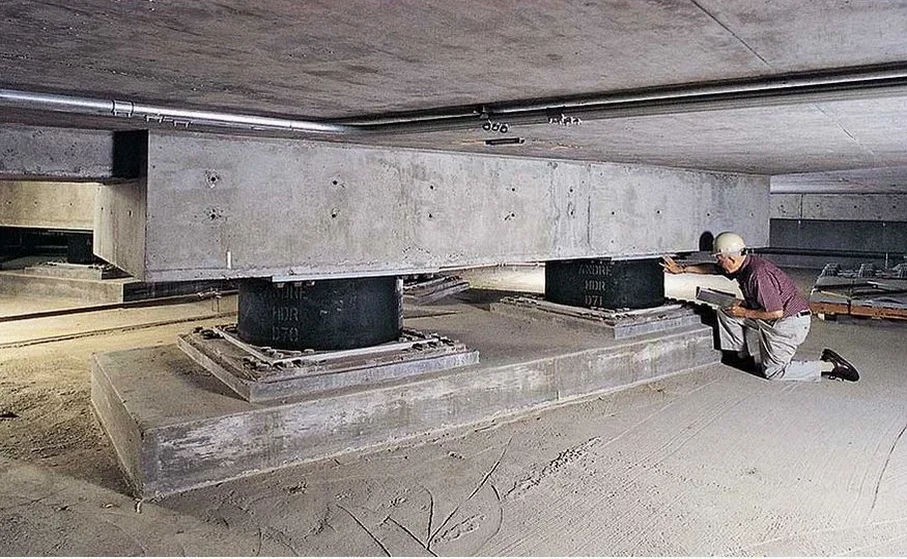
In Norfolk, the subsurface rarely cooperates. You hit water at four feet, the silty clays of the Tabb Formation extend thirty feet down, and the seismic hazard from the Central Virginia Seismic Zone is real but often underestimated. Many engineers here still design fixed-base structures, treating Chapter 17 of the IBC as an afterthought. That approach fails when the fundamental period of the soft soil amplifies ground motion instead of damping it. Our team applies base isolation seismic design per ASCE 7-22 Section 17.2 to shift the structure's period beyond the site's predominant range. The result is not theoretical—it is a measured reduction in spectral acceleration that protects critical facilities, data centers, and healthcare buildings across Hampton Roads. A proper seismic site classification is the starting point; without it, the isolator properties are just guesses.
An isolated structure in Norfolk's Site Class E soils can see a 60-70% reduction in base shear compared to a fixed-base design.
How we work
Local ground factors
The most common mistake we see in Hampton Roads is designing isolators with nominal soil properties and then discovering the site is softer than assumed. A contractor once installed LRBs based on a Site Class C assumption, only for our cross-hole tests to confirm Site Class E. The isolator displacement jumped 40%, the moat wall was undersized, and the retrofit cost triple what the original study would have cost. Another frequent error is ignoring the vertical component of near-field earthquakes—the 2011 Mineral, Virginia event reminded everyone that the passive margin still delivers a punch. Base isolation seismic design in Norfolk cannot rely on West Coast assumptions; the attenuation of motion through the Atlantic Coastal Plain sediments changes the frequency content entirely. We always verify the geophysical profile with a shear wave velocity survey before finalizing the isolator design.
Regulatory framework
ASCE 7-22, IBC 2024, ASTM D1586, ASTM D2487, FEMA P-1051
Related services
Nonlinear Time-History Modeling
Full 3D modeling of the superstructure and isolation layer in ETABS or SAP2000, with upper and lower bound isolator properties per ASCE 7-22 §17.2.8.
Isolator Testing Protocol
Specification development and review of prototype and production tests per ASCE 7-22 §17.8, including aging, scragging, and temperature effects.
Peer Review & Construction Support
Independent technical review of the isolation design, plus field verification of isolator installation, moat wall details, and utility crossings.
Typical parameters
Quick answers
How much does a base isolation design package cost for a typical Norfolk building?
For a mid-rise structure in Norfolk, a full base isolation seismic design package typically ranges from US$4,800 to US$7,370, depending on the complexity of the nonlinear modeling and the number of ground motion pairs required for the peer review panel.
Does the IBC require base isolation for any building type in Virginia?
The IBC 2024 does not mandate base isolation for a specific occupancy, but Section 17 encourages its use for Risk Category IV structures where conventional fixed-base design cannot practically meet the enhanced performance objectives. Many healthcare and emergency response facilities in Virginia select isolation to achieve immediate occupancy after the design earthquake.
How do Norfolk's soft clays affect isolator performance?
The Tabb Formation clays create a Site Class D or E profile that lengthens the ground motion's predominant period. This can increase spectral displacement demand on the isolators. We account for this by using site-specific response spectra and checking that the isolated period is sufficiently separated from the soil's fundamental period to avoid resonance.
What is the difference between LRB and FPS isolators for coastal Virginia conditions?
Lead-rubber bearings provide hysteretic damping through a lead core and are cost-effective for moderate displacement demands. Friction pendulum systems use sliding surfaces with a defined radius to control period and add friction damping. In Norfolk's high-water-table environment, FPS units often simplify corrosion protection because the stainless steel sliding surface is inherently resistant to the humid, saline atmosphere.