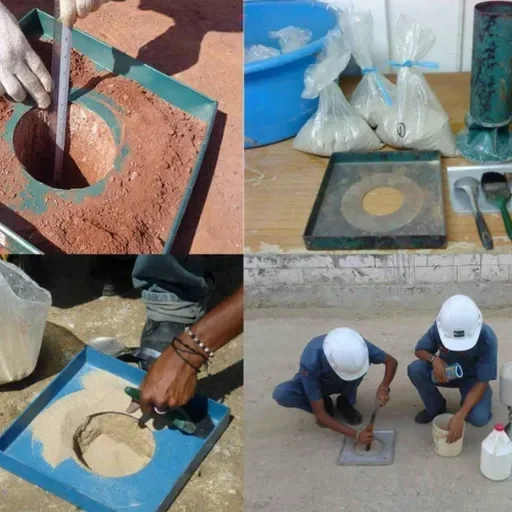
A common mistake we see on Norfolk job sites is signing off on backfill compaction based solely on the compactor’s pass count. That gamble falls apart fast when settlement cracks appear six months after paving—especially in this city, where underlying marine clay and fluctuating water tables create a tricky compaction environment. The sand cone test, run per ASTM D1556, measures in-place density directly, giving you a number you can defend to the city inspector and the design engineer. We’ve pulled cores behind crews working the I-64 widening and new mid-rise foundations near the Elizabeth River, and the difference between assumed density and measured density often exceeds five percent. That gap translates directly into future maintenance costs. When layered fills are placed over compressible Norfolk soils, spot-checking with the plate load test can provide a complementary stiffness modulus, confirming that the compacted lift isn’t just dense but structurally competent.
Pass-count compaction control without density verification is the single largest source of post-construction settlement claims in Hampton Roads.
How we work
Local ground factors
Norfolk’s subtropical humidity and frequent tidal flooding create a compaction risk that drier inland projects rarely face. A fill that compacts beautifully on a Tuesday can become over-optimum by Thursday if a nor’easter moves through and saturates the stockpile. The sand cone test detects this shift immediately because the field moisture sample is weighed on-site, and the technician can flag a moisture deviation before the next lift goes down. Skip that check, and you risk placing a lift that looks tight under the roller but will lose density as the pore pressure dissipates over weeks—leaving pavement sections with hidden voids. In layered fills deeper than four feet, this effect compounds. We have seen final floor slabs in Norfolk warehouses deflect by over an inch because the bottom lifts were never verified during construction. The cost of a density test is negligible against the cost of slab replacement.
Regulatory framework
ASTM D1556: Standard Test Method for Density and Unit Weight of Soil in Place by Sand-Cone Method, ASTM D1557: Standard Test Methods for Laboratory Compaction Characteristics of Soil Using Modified Effort, ASTM D698: Standard Test Methods for Laboratory Compaction Characteristics of Soil Using Standard Effort, AASHTO T 191: Density of Soil In-Place by the Sand-Cone Method
Related services
Field Density Testing (Sand Cone)
ASTM D1556 density and unit weight measurement on compacted fills, utility trenches, pipe bedding, and structural backfill. Technician arrives with calibrated sand, base plate, and field scale. Each station includes moisture content determination and percent compaction calculation against the project Proctor curve.
Laboratory Compaction (Proctor)
Standard or modified Proctor testing on the exact material from your Norfolk borrow source. We run the curve before field testing begins so the compaction spec is tied to real material behavior, not a textbook number.
Typical parameters
Quick answers
How many sand cone tests are required per lift?
The frequency is set by the project specification, but a common rule of thumb in Norfolk is one test per 1,500 square feet of each compacted lift, with a minimum of three tests per lift for smaller areas. Utility trenches often require one test every 50 linear feet. The city’s Department of Utilities may impose tighter frequencies for trench backfill in public right-of-way.
What does a field density test cost in Norfolk?
A typical sand cone density test in Norfolk runs between US$100 and US$140 per station, depending on the number of stations per mobilization and the travel distance to the site. That price includes the field measurement, moisture content determination, and the percent compaction calculation against your Proctor curve. Mobilization is priced separately.
Can the sand cone be used in gravel or crushed stone?
ASTM D1556 limits the sand cone method to soils with a maximum particle size of about 2 inches. Open-graded gravels and clean crushed stone allow the calibrated sand to migrate into voids, which produces a false high-volume reading and an unreliable density. For those materials we recommend alternative methods such as the water replacement test or nuclear density gauge with proper calibration.
Do you need a Proctor curve before running field density tests?
Yes, and it must be a Proctor curve developed on the exact material being placed. Without a valid reference maximum dry density, the percent compaction calculation has no meaning. We run the Proctor in our lab from a bulk sample taken at the borrow source or stockpile before the first field test. If the borrow source changes mid-project, the Proctor must be re-run.