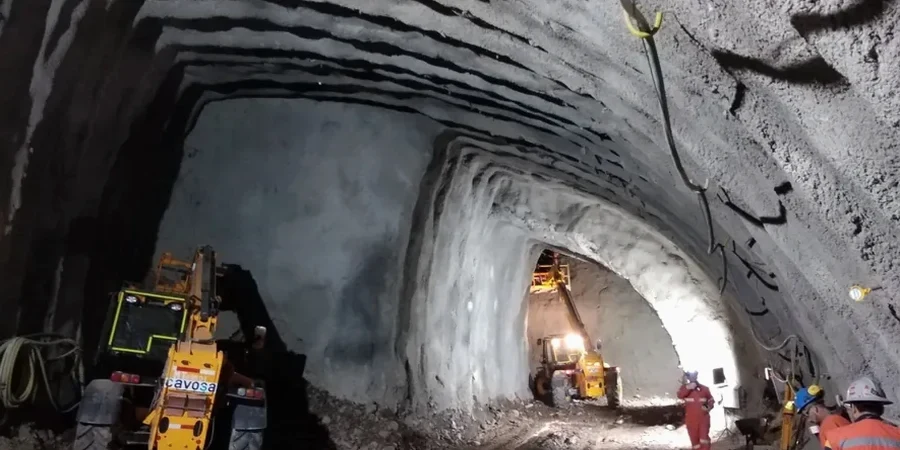
Tunneling through Norfolk's coastal plain geology is a challenge that separates experienced contractors from the rest. The city sits on the Atlantic Coastal Plain, where subsurface conditions are dominated by the Quaternary-age Tabb Formation and the underlying Yorktown Formation. These layers bring interbedded soft clays, loose silty sands, and a notoriously high water table that hovers just a few feet below the surface. A standard site investigation won't cut it here. The geotechnical analysis for soft soil tunnels requires a focused look at undrained shear strength, consolidation characteristics, and the real risk of face instability during excavation. Our lab processes undisturbed Shelby tube samples under ASTM D4767 standards to deliver the triaxial data that tunnel designers in Norfolk actually need. Before committing to a TBM drive or sequential excavation method, integrating data from a CPT test provides the continuous stratigraphic profile that complements discrete boring logs and helps map the interface between the soft upper clays and the denser sands below.
Soft soil tunneling in Norfolk is a race against groundwater and time-dependent deformation—our lab data gives your design team the parameters to win it.
How we work
Local ground factors
Norfolk's development history left more underground surprises than most cities. The downtown area expanded through extensive filling of creeks and marshland during the late 19th and early 20th centuries—meaning your tunnel alignment might transition from natural Pleistocene deposits into undocumented artificial fill without warning. These fill zones often contain timber piles, brick rubble, and organic debris that create differential settlement risks and potential obstructions for tunnel boring machines. A geotechnical analysis for soft soil tunnels that doesn't account for this anthropogenic geology is incomplete. We cross-reference historical Sanborn maps with current boring data to identify these transitions early. The other silent threat is the long-term settlement trough: Norfolk's soft clays continue to deform under load for years, potentially impacting adjacent structures, buried utilities, and surface infrastructure. Our consolidation testing program, paired with settlement monitoring recommendations, builds the mitigation strategy before the first inch of excavation.
Regulatory framework
ASCE 7-22 (Chapter 26), ASTM D4767 (Consolidated Undrained Triaxial), ASTM D6913 (Grain Size Distribution), ASTM D4318 (Atterberg Limits), IBC 2021 (Virginia USBC adoption)
Related services
Advanced Laboratory Testing for Tunnel Design
Consolidated-undrained triaxial tests with pore pressure measurement, constant-rate-of-strain consolidation, and ring shear residual strength testing. All performed on high-quality thin-walled tube samples taken within the tunnel horizon.
Face Stability and Settlement Assessment
Analytical and numerical evaluation of tunnel face support pressure, short-term ground loss, and long-term consolidation settlement. Includes influence zone mapping for adjacent infrastructure protection.
Typical parameters
Quick answers
What's the typical cost range for a geotechnical analysis for a Norfolk soft soil tunnel project?
The investigation scope varies with tunnel length and depth, but for a typical Norfolk soft soil tunnel alignment of 500 to 1,500 linear feet, the geotechnical analysis and laboratory testing program generally ranges from US$4,310 to US$14,620. This covers undisturbed sampling, triaxial and consolidation testing, and the engineering report with design parameters. Longer alignments or complex groundwater conditions shift the scope toward the upper end.
How do you handle the high groundwater table during tunnel investigations in Norfolk?
We use mud rotary drilling with polymer-based fluids to maintain borehole stability through the saturated sands and soft clays. Piezometers are installed in separate boreholes to capture the true phreatic surface and any artesian pressures in deeper sand lenses. The data feeds directly into the dewatering and face pressure calculations for the contractor.
Can your lab test the sensitivity of Norfolk's clays for TBM tunneling?
Yes. We quantify sensitivity through a combination of unconfined compression on intact samples and remolded strength testing. Norfolk's Tabb Formation clays frequently show sensitivity values between 4 and 8, which is critical for estimating the remolding effect at the cutterhead and the required conditioning agent dosage for the TBM.