The drilling crew sets up the CPT rig on a tight downtown Norfolk lot, pushing the cone through layers of sand and soft clay while the data logger streams sleeve friction and pore pressure in real time. That continuous profile feeds directly into the raft design model. Norfolk\'s coastal plain geology—Pleistocene-age deposits overlying the Yorktown Formation—rarely offers uniform bearing. A mat foundation distributes structural loads across the entire footprint, bridging pockets of loose fill and the organic silts common near the Lafayette River and Mason Creek tributaries. The laboratory team processes undisturbed Shelby tube samples alongside the field data, running consolidation and triaxial tests to lock in the modulus of subgrade reaction. Without that site-specific input, the finite element model is just guessing. In Norfolk\'s variable subsurface, we pair the CPT campaign with triaxial testing to capture drained strength parameters for the bearing layer, and we run Atterberg limits on every soft clay seam to flag potential consolidation settlement before the structural engineer ever sees the numbers.
A mat foundation in Norfolk\'s tidewater soils succeeds or fails on the accuracy of the subgrade reaction modulus—guess that number and you inherit the settlement.
How we work
Local ground factors
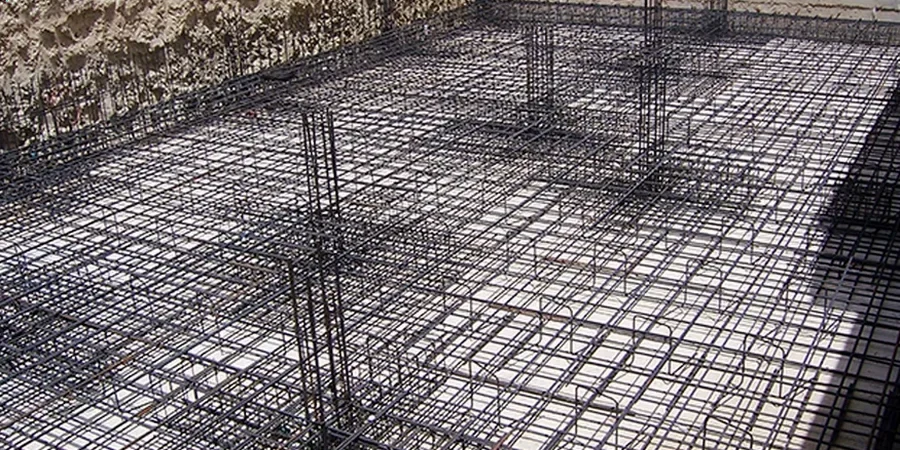
A mat foundation designed for a site in Ghent on the firm Yorktown sand performs differently than one placed on the thick compressible clays mapped near the industrial waterfront along the Elizabeth River. In Ghent, total settlement is rarely the problem—the controlling check is usually punching shear at column drops. Down by the river, though, we have measured 4 inches of consolidation settlement in the upper organic clay layer over a 12-month monitoring period. That magnitude of movement, if not accounted for in the raft design, cracks partition walls and binds elevator rails. The risk compounds when the mat spans across a transition zone between cut and fill. Norfolk\'s historic development pattern filled marshes and creeks with uncontrolled material—old brick, timber, dredge spoil—and that fill thickness varies block by block. Differential settlement is the failure mode we see most often in forensic reviews of distressed mat foundations. The fix costs ten times more than the additional geotechnical investigation would have. Running CPT soundings on a tight grid before finalizing the mat geometry catches those transitions before they become structural problems.
Regulatory framework
ASCE 7-22 Minimum Design Loads and Associated Criteria for Buildings and Other Structures, IBC 2021 Chapter 18 Soils and Foundations, ASTM D1586 Standard Test Method for Standard Penetration Test (SPT) and Split-Barrel Sampling of Soils, ASTM D2487 Standard Practice for Classification of Soils for Engineering Purposes (Unified Soil Classification System), AASHTO LRFD Bridge Design Specifications (for transportation-related mat foundations)
Related services
Mat Foundation Geotechnical Design Parameters Report
Site-specific report providing allowable bearing pressure, modulus of subgrade reaction (ks), total and differential settlement estimates, buoyant unit weight corrections for high groundwater, and seismic site class per ASCE 7-22. Includes CPT logs, laboratory consolidation curves, and triaxial strength envelopes for each bearing stratum.
Construction-Phase Subgrade Verification
Proof-rolling observation and nuclear density testing of the exposed subgrade prior to mud-slab placement. We verify that the bearing surface matches the design assumptions, identify soft spots requiring over-excavation, and document compaction in accordance with project specifications.
Typical parameters
Quick answers
What is the typical cost range for a raft/mat foundation geotechnical investigation in Norfolk?
For a typical Norfolk mid-rise project requiring CPT soundings, laboratory testing, and a full design-parameter report, the investigation budget ranges from US$940 to US$3,800 depending on the number of test locations, depth of exploration, and complexity of the laboratory program. A small single-family mat on a tight lot falls toward the lower end; a multi-story mixed-use building with deep compressible layers and liquefaction screening runs toward the upper end.
How deep should borings or CPT soundings go for a mat foundation in Norfolk\'s coastal plain?
The IBC requires exploration to a depth where the stress increase from the foundation is less than 10 percent of the existing effective overburden stress. For a wide mat—say 60 by 80 feet—that often means 40 to 60 feet below grade in Norfolk\'s interbedded profile. We extend at least one boring deeper, to 80 or 100 feet, when shear-wave velocity data is needed for Site Class determination per ASCE 7-22.
Do Norfolk building officials require a stamped geotechnical report for mat foundation permits?
Yes. The City of Norfolk Department of Planning and Community Development requires a geotechnical report sealed by a Virginia-licensed professional engineer for any structure requiring a building permit where a mat or raft foundation is proposed. The report must address bearing capacity, settlement, groundwater conditions, and compliance with the IBC and Virginia Uniform Statewide Building Code.