The IBC Chapter 18 and ASCE 7-22 mandate specific geotechnical parameters for any excavation exceeding 20 feet in Norfolk—a threshold that nearly every downtown parking garage and mid-rise project crosses. Norfolk sits on the Atlantic Coastal Plain, where the sedimentary profile alternates between loose sands of the Norfolk Formation and compressible silty clays of the Chesapeake Group. We run the full design sequence: finite element modeling of staged excavation, basal heave checks per FHWA guidelines, and lateral earth pressure diagrams for soft-to-medium clays. The water table here sits barely 3 to 6 feet below grade, so in-situ permeability testing feeds directly into the dewatering plan and the strut-level loads we calculate. Every braced cut we design for the downtown district has to account for adjacent brick foundations from the 1920s—structures that tolerate almost zero differential movement.
In Norfolk, the water table at 3 to 6 feet depth makes dewatering design as critical as the structural shoring itself.
How we work
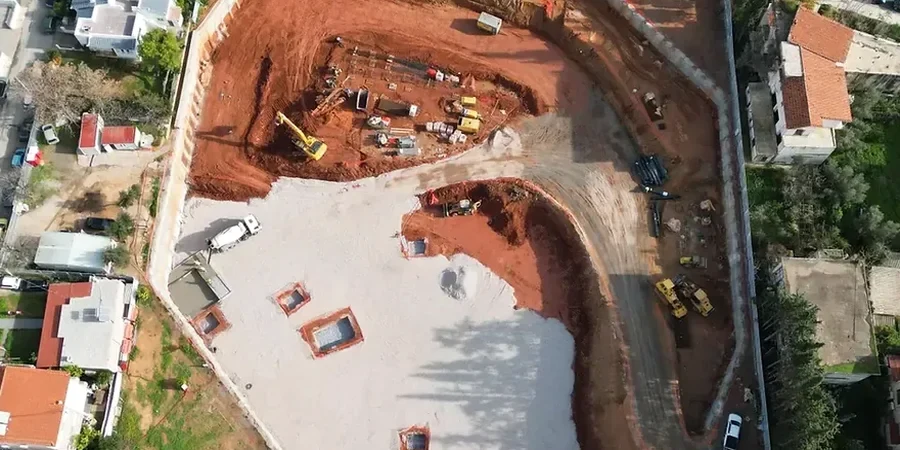
Local ground factors
Norfolk’s elevation averages just 7 feet above mean sea level, and the combination of high groundwater and loose estuarine deposits has caused at least three documented excavation collapses in the Hampton Roads region since 2005. The most common trigger is basal heave in soft clay—when the weight of the soil outside the excavation exceeds the bearing capacity of the clay below the cut, the entire floor rises and the bracing buckles inward. We calculate the factor of safety against basal instability using both the Terzaghi and the Bjerrum-Eide methods, and if the number drops below 1.5, we extend the wall embedment or switch to a jet grout bottom seal. Norfolk’s tidal fluctuation—about 2.5 feet between mean low and mean high water in the Elizabeth River—also imposes cyclic pore pressure changes that can soften a clay layer over a six-month construction window. Ignoring that fluctuation means underpredicting wall deflections by 30% or more.
Regulatory framework
IBC 2021 (Chapter 18), ASCE 7-22 (Section 12.13), OSHA 29 CFR 1926 Subpart P, FHWA GEC No. 4 (Ground Anchors), ASTM D1586 (SPT), ASTM D2487 (Soil Classification)
Related services
Braced excavation design
Cross-lot strut and raker systems sized for staged excavation in Norfolk’s soft clays, with corner bracing details and connection design per AISC.
Tieback anchor design
Prestressed grouted anchors designed to transfer load beyond the active failure wedge, with bond length verified against Yorktown Formation parameters.
Dewatering and groundwater control
Flow net analysis and wellpoint or deep well system layout calibrated to Norfolk’s high water table and tidal influence.
Construction-phase monitoring plan
Inclinometer and settlement point arrays specified to track wall deflection and adjacent structure movement against pre-construction baseline surveys.
Typical parameters
Quick answers
What triggers a deep excavation classification in Norfolk?
OSHA Subpart P defines a trench as an excavation deeper than it is wide, and any excavation below 20 feet requires a registered professional engineer’s design. In Norfolk, the IBC also requires geotechnical investigation and engineered shoring for any cut deeper than 5 feet if it is near an existing structure or right-of-way.
How do you handle the high groundwater during excavation?
We design either a deep well system with submersible pumps or a wellpoint vacuum system, depending on the permeability of the strata encountered. The target is to lower the phreatic surface at least 2 feet below the excavation subgrade before any earth removal begins. Norfolk’s tidal fluctuations are factored into the steady-state flow model.
What is the cost range for deep excavation design in Norfolk?
A full geotechnical design package for a braced excavation in Norfolk typically ranges from US$1,840 for a straightforward single-family lot shoring plan to US$8,260 for a multi-level commercial excavation requiring finite element analysis, tieback design, and a dewatering plan.
How do you protect adjacent historic buildings during excavation?
We conduct a pre-construction condition survey and install settlement monitoring points on adjacent structures. The excavation support system is modeled with reduced allowable wall deflection—often 0.25 inches or less—and we specify compaction grouting or underpinning if the predicted settlement exceeds the building’s tolerable movement.