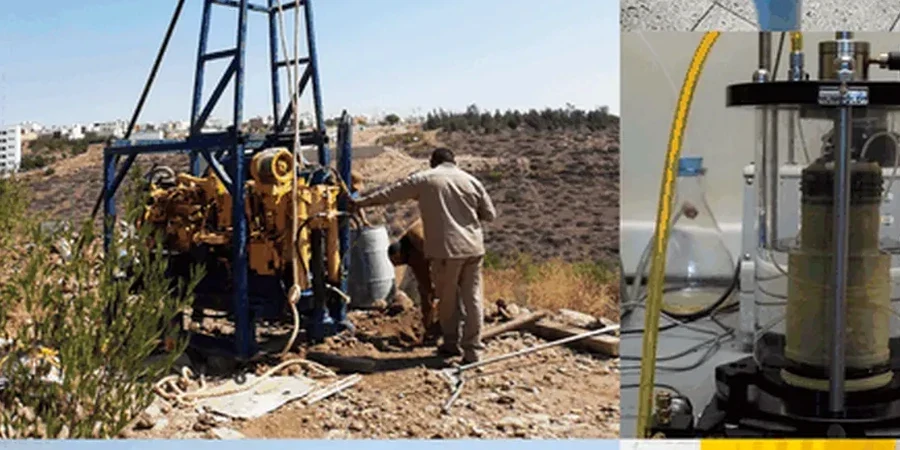
Norfolk’s expansion as a naval and logistics hub since the early 20th century has pushed development onto filled marshland and estuarine deposits that demand rigorous subsurface characterization. A soil mechanics study here is not a generic checklist item. The city sits barely 10 feet above mean sea level on the Atlantic Coastal Plain, where Holocene silts and soft organic clays alternate with discontinuous sand lenses. Our team runs consolidated-undrained triaxial tests and incremental oedometer loading to capture the consolidation behavior of the Yorktown Formation remnants, which govern settlement predictions under heavy waterfront structures. In areas like Ghent or Ocean View, the transition from historic fill to natural marine sediment creates a stiffness contrast that must be mapped before any deep excavation or pile design proceeds. When the upper layers show low blow counts, we correlate the soil mechanics study with an SPT drilling campaign to verify refusal depth for end-bearing piles.
The Yorktown Formation clay in Norfolk can lose 60% of its undrained shear strength when remolded under cyclic loading from heavy cranes or pile driving.
How we work
Local ground factors
The Norfolk Crust—a desiccated upper layer of stiff clay overlying soft compressible strata—misleads many investigations. At 4 to 8 feet depth, the blow count drops from 15 to 3, creating a bearing capacity trap for shallow footings. A soil mechanics study that stops at 10 feet misses the weak zone entirely. Differential settlement across the crust boundary can exceed 2 inches over a 30-foot span, cracking masonry and racking steel frames. The second risk is sulfate attack. Pore water extracted from the Lafayette Formation and overlying marsh deposits shows sulfate concentrations above 1,500 ppm, which triggers Type V cement requirements per ACI 318-19. Without chemical analysis from the soil mechanics study, the concrete specification may be under-designed for a 50-year service life. The third concern is excavation base instability. In the Downtown Tunnel expansion, basal heave of marine clay under 40-foot cuts required jet grout stabilization because the factor of safety against bottom blowout fell below 1.2.
Regulatory framework
ASTM D2487-17: Standard Practice for Classification of Soils for Engineering Purposes, ASTM D1586-22: Standard Test Method for Standard Penetration Test (SPT) and Split-Barrel Sampling, ASCE 7-22: Minimum Design Loads and Associated Criteria for Buildings and Other Structures, IBC 2021 (Virginia USBC): Chapter 18 – Soils and Foundations, ASTM D4767-11(2020): Consolidated-Undrained Triaxial Compression Test on Cohesive Soils
Related services
Consolidation and Settlement Analysis
One-dimensional oedometer testing on undisturbed Shelby tube samples from the soft clay layer. We calculate primary consolidation settlement and time rate under structural loads up to 4 ksf, with secondary compression estimates for organic silt layers.
Triaxial Shear Strength Testing
CU and UU triaxial tests with pore pressure measurement on marine clay specimens. Effective stress parameters (c', φ') for long-term slope stability and total stress parameters (Su) for short-term bearing capacity in undrained loading conditions.
Chemical and Corrosivity Analysis
pH, resistivity, sulfate, and chloride content from groundwater and soil samples. Direct input for ACI 318-19 concrete exposure classes and corrosion protection design for steel piles driven into Norfolk’s brackish groundwater.
Typical parameters
Quick answers
What is the typical cost range for a soil mechanics study in Norfolk?
For a standard residential or light commercial lot in Norfolk, a soil mechanics study with two borings, laboratory classification, and a foundation recommendation report typically runs between US$2,860 and US$4,960. The final cost depends on access conditions, depth requirements, and the number of triaxial or consolidation tests requested by the structural engineer.
How deep should the borings go for a soil mechanics study in Norfolk?
The Virginia USBC requires borings to extend through all unsuitable material and at least 30 feet into competent bearing strata. In Norfolk, where the Yorktown Formation provides reliable bearing, borings typically reach 50 to 70 feet to penetrate the soft marine clay and confirm refusal in the dense sand or stiff clay below. Deeper borings are needed for deep pile foundations near the Elizabeth River.
Does Norfolk require a soil mechanics study for residential construction?
Yes. The City of Norfolk Department of Planning and Community Development enforces the USBC, which mandates a geotechnical investigation for all new structures. Given the prevalence of fill soils, high groundwater, and potential for differential settlement in neighborhoods built on former marshland, the building official will not issue a permit without a stamped soil mechanics study confirming bearing capacity and settlement estimates.